Every clean, controlled, standard-issue delay sound — plus some new tricks: tape saturation and tape wear, oscillating tap density, tremolo, chorus, and stereo effects, with ranges that go way beyond the limits of most other delays.
Mac & Windows · VST3 & AU · No DRM · No subscriptions · No dongles · No iLok · Perpetual license
Everything from clean slap-back and rhythmic multi-tap patterns to tape-saturated chaos at the far end of every knob — taps warped and pulled toward a single point in time, like light bending near a black hole. Warp Delay doesn't clamp the extremes off to keep you safe: turn a parameter all the way and it goes all the way.
The Randomize button isn't a novelty reset. Every parameter it touches is individually selectable, so you decide what's fair game and what stays locked in place. Randomize only Warp and density while your tone controls stay put, and you'll land on tap patterns you'd never have dialed in by hand. Step back through your history with the arrow controls if a happy accident is worth keeping.
Stretches and breaks the delay tap distribution — squish taps so close they collapse to a singularity, or pull them further apart. The plugin's namesake control and its visual centerpiece: automate it from your host and real pitch-shift artifacts start showing up as taps collapse, movement a static knob position can't give you.
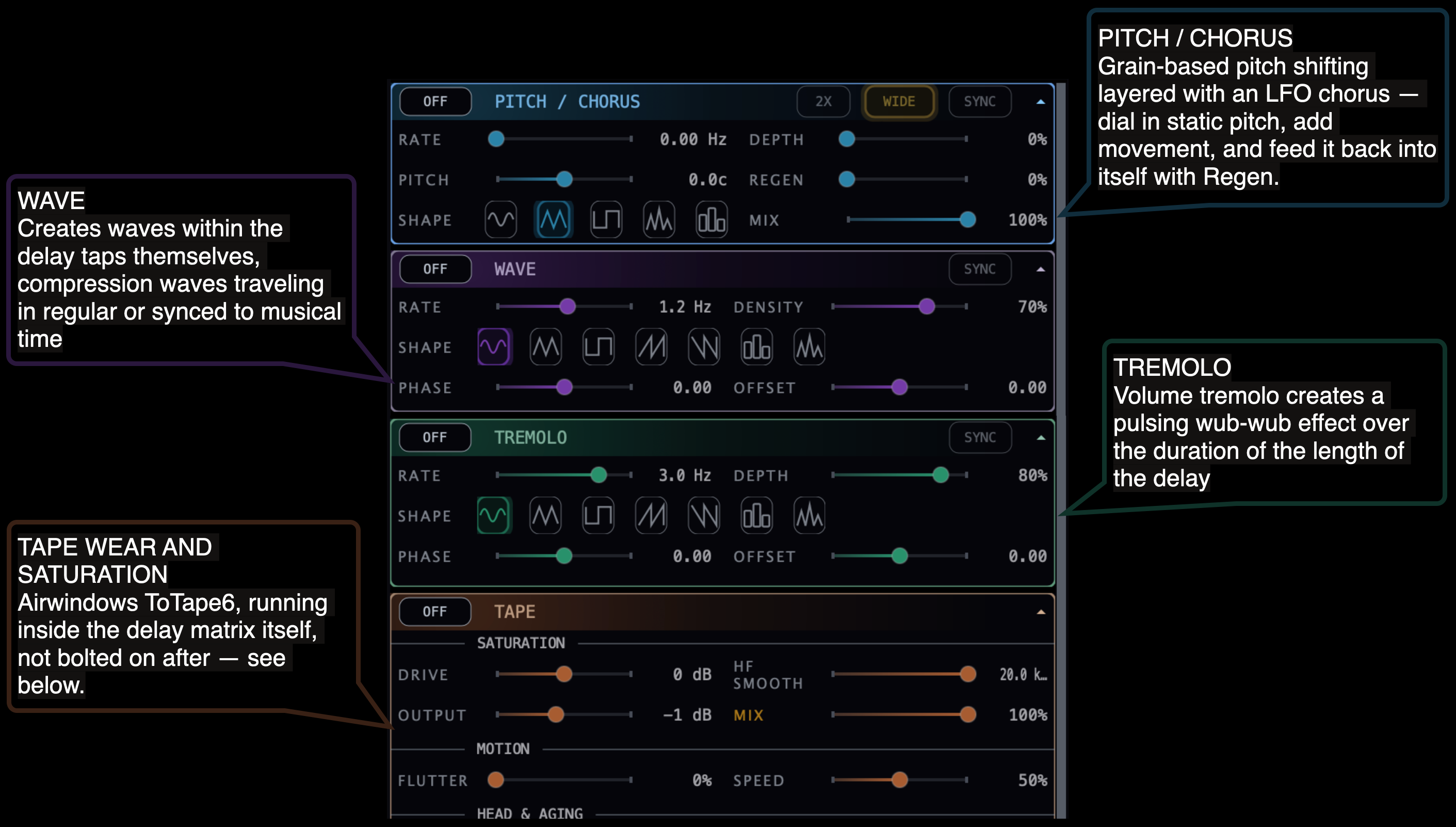
Four effect sections, each its own accordion, stacked after the core delay engine.
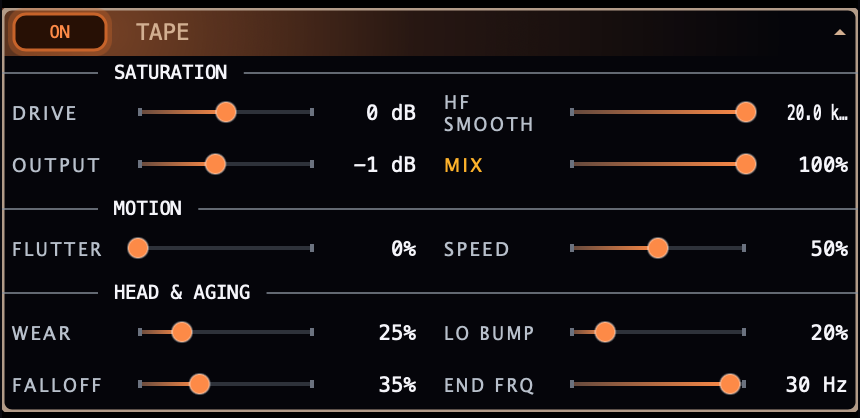
The tape stage traces back to Airwindows — ToTape6 (Patreon-funded, MIT-licensed). It isn't a straight port: this version runs inside the delay matrix itself, at the record head, so saturation and tape wear compound with every feedback pass instead of coloring the signal once on the way through, like a series effect would. MIT License, Airwindows.
Slide the crossfader to hear the "wet" effect.
Try this: ambient pillowy echoes, heavily lowpassed with consistent delay tap timings.
Use as a thickener: Engage Chorus and Wide on a simple synth sound and each delay tap essentially becomes a new oscillator, adding up to 64 additional detuned voices, thickening the sound, and giving new life to ordinary sounds. Add Tape drive for more harmonic saturation.
Try this: push the drums through a single low-latency (1ms) delay tap, and use Tape drive and head bump to saturate your drums. Alternatively, use tape wear to degrade your sound.
Try this: use the Wave effect to create ripples in the delay line. Use Tremolo to create volume pulses.
Most delay plugins give you one or two taps and a feedback knob. Warp Delay runs a full multi-tap matrix with independent In/Out density curves, tape saturation built into the feedback loop itself — not chained after — and Tremolo, Wave, and Pitch/Chorus stacked inside the same signal path instead of three separate plugins.
Tape saturation and tape wear live inside the delay's own feedback path. Warp Delay's tape compounds with every repeat instead of coloring the output once, and its warp curve gives you a physical, visual handle on the plugin's most experimental corner. Further refinements include tape head bump, high-frequency rolloff, and variable speed and intensity tape flutter.
Automate Warp Delay's warp curve from your host instead of leaving it static — the pitch-shift artifacts it throws off as taps collapse are a modulation source most plugins can't fake. Run a drum hit through with In/Out density maxed and Decay curve steep for a granular-adjacent texture. Automate density and Warp in opposite directions and the whole tap pattern turns inside out.
Mac & Windows · VST3 & AU · No DRM · No subscriptions · No dongles · No iLok · Perpetual license
Already purchased? Download the installer, then activate with the license code from your purchase email.