Images
Right-click / long-press to save. Full resolution, no compression beyond the source file.




Headshot — pending
Developer headshot
Everything below is free to use without asking. No login, no form — if something you need isn't here, email [email protected] directly.
Copy-pasteable as a unit.
Pick whichever fits your slot — nobody has to edit this down for you.
Warp Delay is a multi-tap delay with tape saturation built into the feedback loop itself — every clean delay sound, plus the extremes other plugins clamp away.
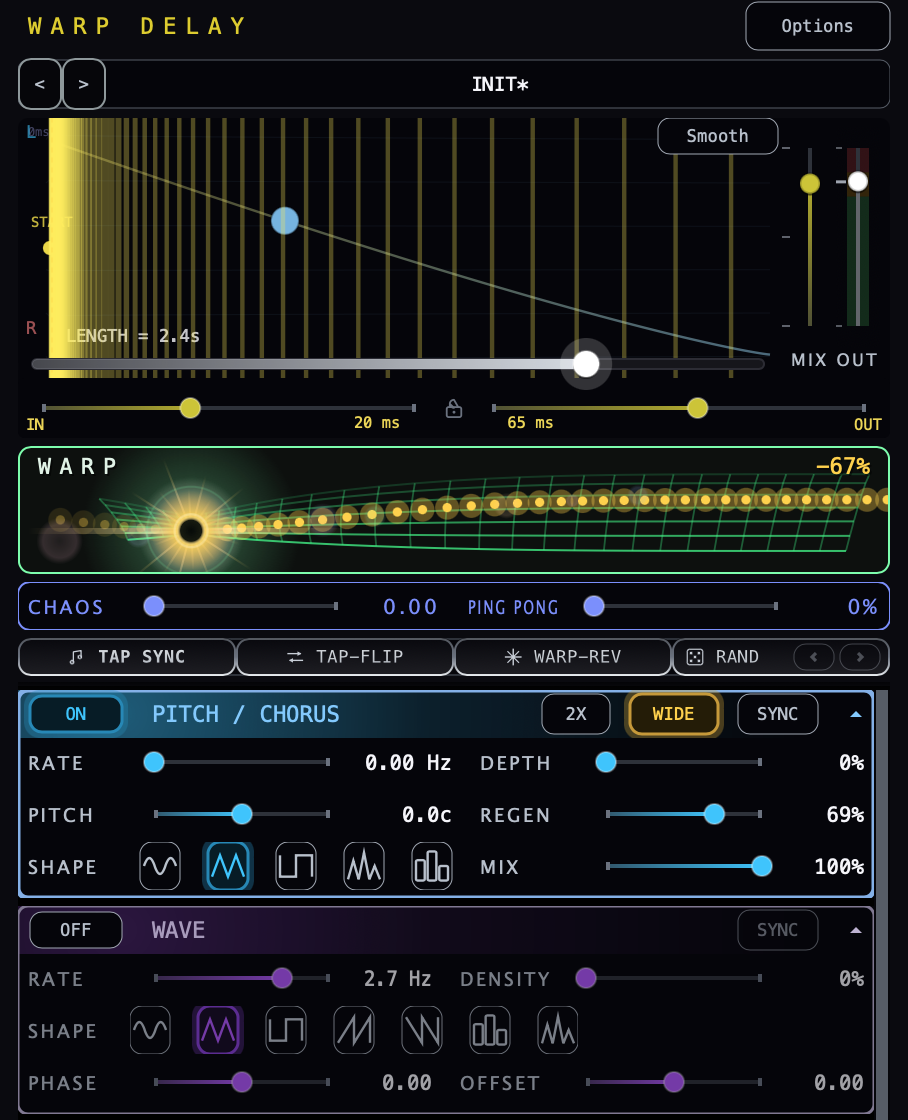
Warp Delay is a multi-tap delay plugin: independent In/Out tap density, a tape stage (built on Airwindows' ToTape6) running inside the feedback path so saturation compounds with every repeat, and a namesake Warp control that pulls taps toward a single point in time for real pitch-shift artifacts under automation.
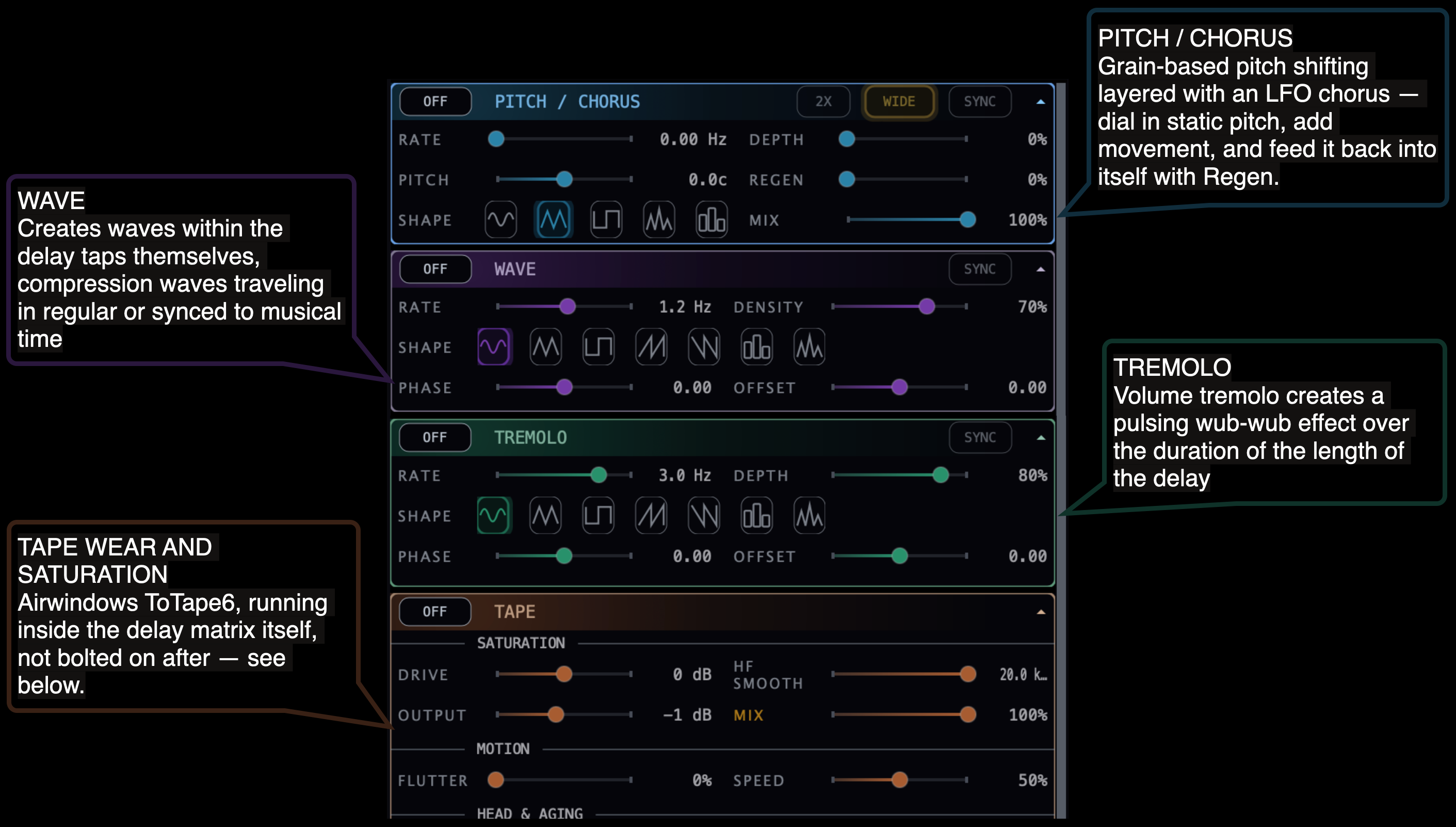
Warp Delay is a multi-tap delay plugin for macOS and Windows (VST3/AU). Most delay plugins give you one or two taps and a feedback knob; Warp Delay runs a full multi-tap matrix with independent In/Out density curves and a variable decay curve, not just a level. Its tape stage traces back to Airwindows' ToTape6 (MIT-licensed) — not a straight port, but rewired to run at the record head inside the delay's own feedback loop, so saturation and tape wear compound with every pass instead of coloring the signal once. The namesake Warp control stretches and collapses the tap distribution toward a singularity; automated from a host, it throws off real pitch-shift artifacts as taps collapse — movement a static knob can't give you. Tremolo, Wave (a spatial LFO), and a grain-based Pitch/Chorus section are stacked into the same signal path instead of living as three separate plugins. $59 ($39 intro), no DRM, perpetual license.
Warp Delay is a multi-tap delay plugin for macOS and Windows, available as VST3 and Audio Unit. It's built to cover every normal delay sound a mix needs, and then keep going past where most delays stop.
The delay engine itself runs a full multi-tap matrix rather than the single tap and feedback knob most delay plugins offer: In and Out tap density are independently controllable (locked together or set apart for a spray that thins or thickens over time), decay is a curve rather than a flat level, and delay length runs up to 12 seconds. Sync Mode locks density and length to the host tempo grid.
Its tape stage traces back to Airwindows' ToTape6, a Patreon-funded, MIT-licensed tape emulation. Warp Delay doesn't chain it on as a separate effect afterward — it runs at the delay's own record head, inside the feedback loop, so saturation and tape wear compound with every repeat instead of coloring the signal once on the way through. Head bump, high-frequency rolloff, and variable-speed tape flutter round it out.
The plugin's namesake control, Warp, stretches and pulls the tap distribution toward a single point in time — squish taps close enough and they collapse to a singularity, like light bending near a black hole. Automated from a host instead of left static, it produces real pitch-shift artifacts as taps collapse: a modulation source most plugins have no way to fake.
Beyond the core engine: Ping Pong spreads repeats across the stereo field; a grain-based Pitch/Chorus section layers static detune with LFO movement; Tremolo adds tempo-synced volume modulation; Wave is a spatial LFO that modulates tap position and spacing over time. All four live inside the same signal path as the delay and tape stage, instead of requiring three or four separate plugins chained together.
Warp Delay is $59 (currently $39 as an intro price). No DRM — no dongle, no iLok, no subscription. Licensing is offline and hardware-locked, activated once per machine, perpetual after that. A free 30-day trial and a permanently free, feature-limited Lite edition are both available without a purchase.
Written to be quoted verbatim.
Most delay plugins treat tape saturation as a coat of paint applied once, on the way out. Warp Delay puts it inside the feedback loop instead, at the record head, so every repeat saturates and degrades a little more than the last — the tape stage compounds instead of just coloring. Paired with a tap-warping control that collapses the whole delay pattern toward a single point in time under automation, it's less "delay plus a tape plugin" and more an instrument for what a delay's own feedback path can be pushed to do.
Draft — Joel to edit for accuracy before publishing.
Joel Abbott is a Broadway [TODO: role/credits] with an M.F.A. in [TODO: field/program], building audio plugins as Shades Of Toast. Warp Delay is his first commercial release.
Joel Abbott spent [TODO: years/credits] working on Broadway as a [TODO: role] before turning to audio plugin development, holding an M.F.A. in [TODO: field/program] from [TODO: institution]. Shades Of Toast grew out of building tools for his own sound work — Warp Delay is the first of those tools released commercially, alongside a growing set of free utilities.
Dry and wet, so you can A/B honestly. Each pair below also links directly to its two source MP3s.
Ambient, pillowy echoes, heavily lowpassed with consistent tap timings.
Dry source · Wet source
Chorus + Wide engaged on a simple synth — each delay tap becomes a new detuned voice, up to 64 of them.
Dry source · Wet source
A single low-latency (1ms) tap with Tape drive and head bump for saturation, plus tape wear for degradation.
Dry source · Wet source
Wave creates ripples in the delay line; Tremolo adds tempo-synced volume pulses.
Dry source · Wet source
Right-click / long-press to save. Full resolution, no compression beyond the source file.
Developer headshot
Full-featured, non-transferable license, free for press, reviewers, artists, and beta testers.
48-hour response time.
Added here as reviews come in.
Joel Abbott — [email protected]. Available for interviews.